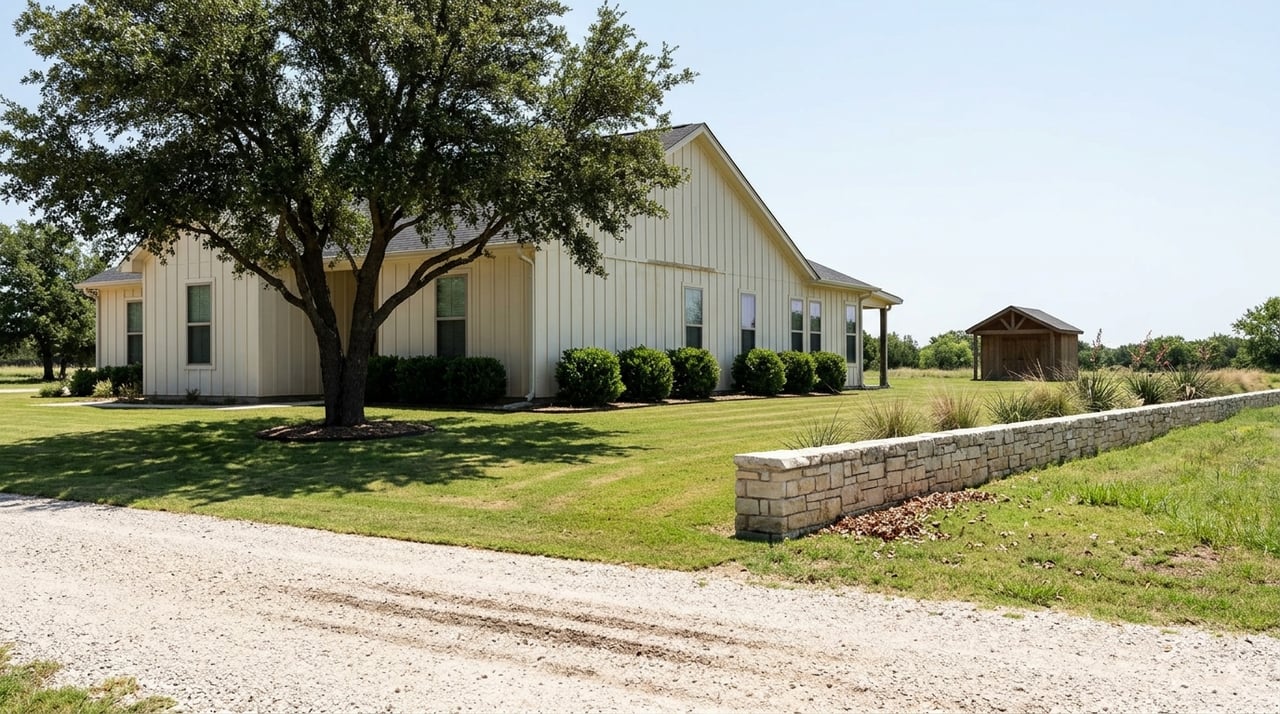
A Godley listing can check every box a buyer cares about. Good bones, a fair price, a shaded lot on two or three acres. Then, three weeks into the option period, the loan stalls over a measurement nobody thought to ask about: how far the well sits from the septic tank, and how far it sits from the drain field. Not the tank's age. Not whether it was pumped last year. A distance, measured in feet, that has nothing to do with how the house shows and everything to do with whether the loan closes.
This is the part of a Godley purchase that catches people off guard, especially buyers coming from a subdivision where water and sewer just showed up at the curb. Once you understand why this number matters more than almost anything else in a rural transaction, you start touring homes differently.
Two Neighborhoods, One Search Result
Search "Godley homes for sale" on any portal and you'll get a single list, but you're actually looking at two different kinds of property with two different closing processes.
On one side sit the newer, tighter subdivisions built for volume: Star Ranch, Still Water Lake, Wildcat Ridge. Quarter-acre lots, fenced backyards, city utilities. Closing on one of these looks like closing almost anywhere else in the DFW exurbs.
On the other side sit gated acreage communities like Lanzara Ranch, set between Godley and Granbury on two-plus-acre homesites with private water wells and septic systems instead of a city water bill. Co-op electric and fiber run underground, and the appeal is real: no city taxes, more room, a genuine sense of separation from the next house. But every one of those homes depends on a well and a septic system doing their jobs correctly, and that changes what your inspection period needs to accomplish.
Buyers touring both types back to back sometimes carry the same checklist into each house. That's the first mistake. The acreage side of Godley needs its own list, and it starts with a number most people have never had to think about before.
The Distance the Appraiser Actually Measures
Texas sets a baseline separation for private septic systems: a minimum of 50 feet between a well and a septic tank, and 10 feet between the system and the property line. Most conventional buyers never touch this number directly. Their agent orders an inspection, the tank gets checked, and life moves on.
FHA and VA buyers hit a stricter version of the same rule. Per HUD Handbook 4000.1, an FHA loan requires at least 50 feet between the well and the septic tank, and 100 feet between the well and the drain field. VA loans carry a similar requirement that the system be sound and properly sized. Neither program grants exceptions for a system that's otherwise permitted and functioning. If the distance is short, the loan does not close until it's fixed or the buyer switches financing.
Here's the table worth keeping on your phone during a Godley acreage showing:
| Requirement | Well to Septic Tank | Well to Drain Field |
|---|---|---|
| Texas state minimum | 50 feet | Not separately specified |
| FHA (HUD Handbook 4000.1) | 50 feet | 100 feet |
| VA | System must be sound and adequately sized | System must be sound and adequately sized |
The gap between the state minimum and the FHA drain field requirement is where deals quietly die. A system can be fully compliant with Texas rules, permitted, and pumped on schedule, and still fail an FHA appraisal because nobody measured the distance to the drain field specifically. That number rarely shows up on a listing sheet. It takes a site evaluation, a survey, or a call to the installer of record to confirm it, and the earlier that call happens in the option period, the less it costs everyone involved.
Godley's Clay Makes the Margin Thinner
Southern Johnson County sits on heavy clay soil, and that soil behaves differently than the sandier ground in parts of the metro. Drain fields here break down faster than a lot of buyers expect, which means a system that looks fine on paper can be closer to the end of its functional life than its age alone would suggest.
Most rural homes around Godley run 1,000 to 1,500 gallon tanks, sized for acreage rather than a city lot, and the pumping cadence that works in a sandy suburb doesn't necessarily hold up here. Godley Septic, a family-run operation that has worked these roads for more than three decades, sizes and schedules service around the clay rather than a generic interval, because the same three-to-five-year pumping window that works elsewhere can leave a Godley system running past its limit.
That matters for setbacks because a drain field already under stress from clay soil has less room for error. If the well-to-drain-field distance is already tight against the FHA line, a saturated or aging field makes that measurement even more likely to fail scrutiny during underwriting.
The Acreage Exception Nobody Explains Correctly
Buyers looking at Godley's larger tracts, the 15-acre and 50-acre listings that show up alongside the subdivisions, sometimes come across a property with no septic permit on file and assume the worst. That assumption is often wrong.
Texas allows an exemption from local septic permitting for properties of 10 acres or larger, provided the site is evaluated by a licensed site evaluator or professional engineer, the system serves a single-family home, it isn't causing a nuisance or polluting groundwater, and every part of the system sits at least 100 feet from the property line. A missing permit on a large tract doesn't automatically mean an unpermitted or illegal system. It might mean the property legally qualified for the exemption and was never required to file one.
The right move isn't to walk away from the listing or to assume it's fine either. It's to ask the seller for the site evaluator's documentation confirming the exemption conditions were met, the same way you'd ask for a permit on a smaller lot. Johnson County Environmental Health administers this locally under the state's OSSF rules, and getting that paperwork in hand during the option period is far easier than chasing it down after closing.
Who Pays, and Why the Current Market Favors Asking
Texas law doesn't assign responsibility for septic repairs between buyer and seller. It's negotiated inside the option period, and the common outcomes are a seller credit, a price reduction, a completed repair before closing, or the deal falling apart if nobody budges.
Godley's current market gives buyers more room to ask than they might expect. As of early July 2026, active listings in Godley carried a median list price of roughly $446,000 with average time on market running around 118 days, and that median list price had actually ticked down from the prior month. Homes sitting on the market for close to four months, with pricing already softening, put sellers in a position where a reasonable credit for a septic or well issue is far more attractive than losing a buyer over it. A seller who has already absorbed a month or two of stale listing time usually isn't looking for a fight over a $500 pumping bill or a repair credit that keeps the file moving toward closing.
That leverage disappears once the option period ends. If a setback or system issue surfaces after the fact, the negotiating position is gone and the cost lands on whoever owns the house.
Common Questions
Does Texas require a septic inspection before selling a home in Godley?
Not universally. There's no statewide law forcing a septic inspection at every sale. But any FHA or VA buyer will trigger one because their financing requires it, and most local lenders ask for one on well-and-septic properties even outside those programs, since the appraisal itself often depends on confirming the system is functioning and properly set back.
If the septic system needs repair, who has to pay?
Neither party is legally on the hook by default. It gets worked out during the option period, and the usual resolutions are a seller-paid repair, a closing credit, a price adjustment, or the buyer accepting the system as-is in exchange for a lower price. In a market where Godley listings are sitting for months rather than days, sellers generally have more incentive to negotiate than to let the deal collapse.
My dream property is 10-plus acres with no septic permit on file. Is that a problem?
Not automatically. Properties of 10 acres or larger can qualify for an exemption from local septic permitting under Texas rules, provided a licensed site evaluator confirmed the system meets specific conditions, including keeping every component at least 100 feet from the property line. Ask the seller for that evaluator's documentation rather than treating the missing permit as a red flag on its own.
Where This Leaves You
The houses on either side of Godley's utility line look similar from the street. What happens in the thirty days after your offer is accepted is where they diverge, and the well-to-drain-field distance is the single number most likely to decide whether your loan closes on schedule or stalls in underwriting. Knowing to ask about it before you're locked into a timeline is the difference between a smooth closing and a scramble.
If you're weighing a quarter-acre lot in Wildcat Ridge against two acres and a well out toward Lanzara Ranch, that's exactly the kind of comparison Carson Gates walks through with buyers every week, informed by hands-on experience with land, fencing, and rural infrastructure that goes well beyond the listing sheet. Let's connect and figure out which version of Godley actually fits what you're trying to build.